The Science Beneath the Floor
By Mike Niese, Vice President of Sales and R&D, and
James Fayette, Vice President of Business Development for Robbins Dance & Performing Arts
Before we talk about dance floors, we need to talk about sports floors.
That may seem like an unusual place to begin an article about dance and performing arts, but the science behind some of today’s most advanced dance floor systems was forged through decades of biomechanical research in elite athletics. The same questions that drove our work with professional and collegiate athletes, how the human body responds to impact, fatigue, vibration and repetitive movement, ultimately led to innovations that today benefit dancers and performing artists. To understand where our dance floors are today, it helps to understand the path that got us there.
From the DIN Standard to Biomechanics
Prior to the late 1980s, the sports and performance flooring industry was a scene more akin to the Wild West, with manufacturers quick to tout material performance “data” derived from isolated material-based lab tests. These tests lacked both standardization and relevance to real-world human performance, measuring parameters like how deeply a rubber pad indents or compresses under pressure, and results were often presented as indicators of resilience and participant safety. But there was no meaningful science connecting what was being measured and the effects on the human body when interacting with the floor.
This was the state of the industry when Robbins Sports Surfaces decided to take a different path grounded in science, not marketing hype. We weren’t satisfied with knowing how a floor performed in a vacuum. Learning what happens to the human musculoskeletal structure during interaction with a floor is much more important than understanding what happens to a floor system when impacted by a person. That decision and change in direction has made all the difference.
In 1987, we initiated a collaboration with the Otto-Graf-Institute (Stuttgart, Germany) and began working with the Deutsches Institut für Normung (DIN) to explore what were then the most comprehensive material-based standards in the world. We developed half a dozen floor systems that met all the criteria outlined in DIN standards, a first for the U.S. market, and in doing so, began the industry’s first real attempt at standardized performance values for sports floors.
However, the DIN tests, while more rigorous than anything in the U.S. at the time, were still quite limited. These tests were based on impact forces generated by a 150-pound “simulated athlete.” And while useful for evaluating certain material properties, they told us nothing about what actually happens within the human musculoskeletal structure when a person makes contact with the floor. And so, at Robbins, we took our commitment to human safety and performance one step further.
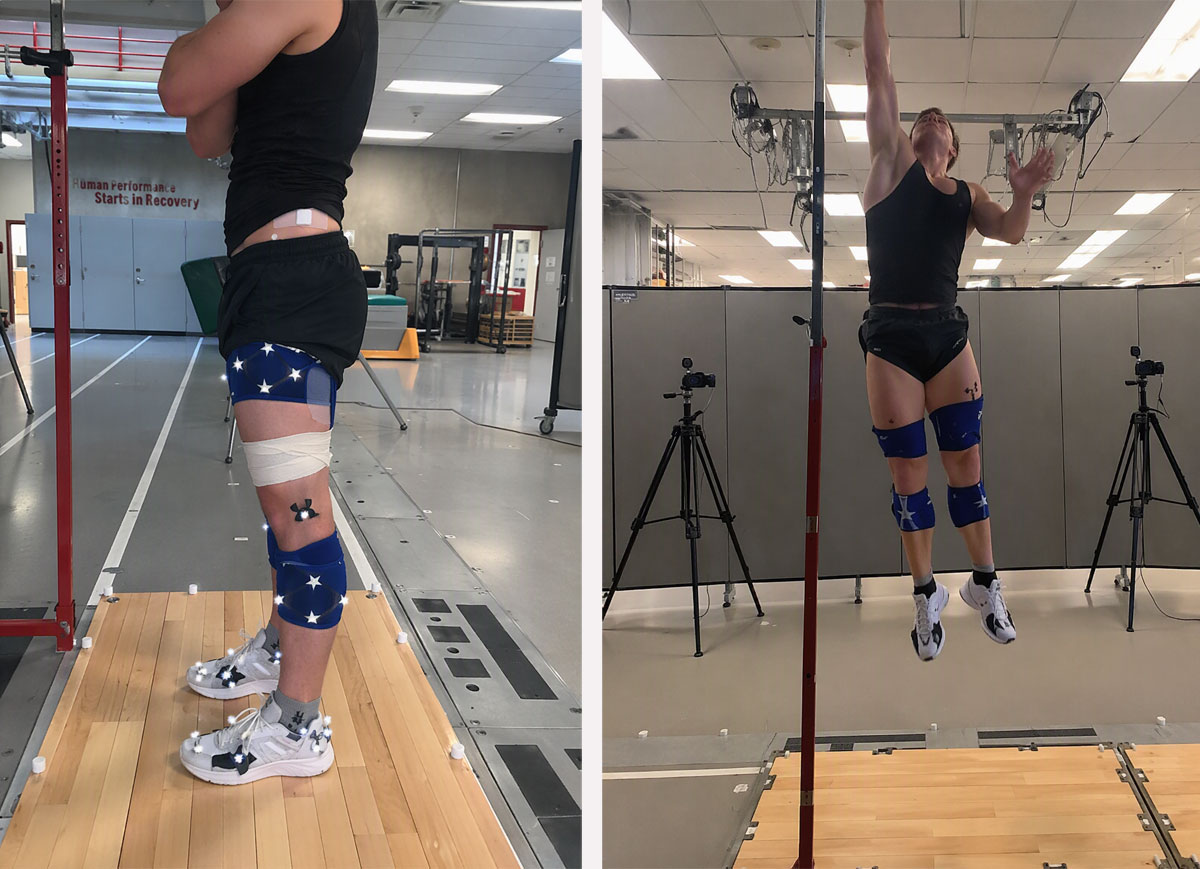
Starting in the early 1990s, we began working closely with the University of Calgary Human Performance Lab and renowned kinesiologist/biomechanist Dr. Benno Nigg. Together, we launched a series of studies designed to analyze the human side of people interacting with a performance floor system; specifically, the effects on joints, muscle groups, fatigue, injury risk and overall biomechanics.
This was not marketing, it was research. The same kind of deep, peer-reviewed, university-backed research that still sets us apart today.
The Birth of MVP™ Technology: Engineering for Performance
The culmination of years of biomechanical research came in the form of one of our most groundbreaking products: MVP (Maximum Vibration Protection). Developed in 1997 and fully launched in 2005 after extensive testing and refinement, the MVP system represented a major departure from traditional sports floor engineering.
Dr. Nigg’s research on the MVP system revealed something extraordinary. The MVP behaved unlike any floor previously researched. Specifically, it demonstrated unique vibration control, damping vibration and aftershock within milliseconds. In engineering terms, we were approaching “critical damping,” a property that dramatically reduces the energy transferred into the human body, lowering fatigue and mitigating injury risk.
This vibration control wasn’t accidental, it was the result of deliberate design. At the time, the MVP’s understructure was so different in appearance from other flooring systems that our own sales team had doubts that it would sell. But the data didn’t lie. As we like to say, “Feeling is Believing.” And once we understood what the system could do for human health and performance, there was no turning back.
From MVP Technology to L-Evate Premium®: Designing for Dance
As we continued our biomechanical investigations, we realized something else: while MVP was delivering extraordinary results for elite basketball and collegiate athletics, the same underlying principles had tremendous potential beyond sports.
Years of research had shown that vibration control, damping characteristics and floor uniformity directly influence how the human body responds to repeated impact. The challenge became how to apply those same benefits to a floor system specifically engineered for the unique movement patterns and lighter body masses of dancers and performing artists.
This led to the development of DanzAire®, now known as L-Evate Premium®, a purpose-built sprung floor system designed specifically for dance.
Drawing directly from the biomechanical principles established through MVP research, we incorporated the same core materials and technologies responsible for MVP’s remarkable vibration damping and uniformity characteristics. However, the system was redesigned to respond perfectly to the demands of dance and performing arts.
The key innovation involved reducing the resistance to compression ratio at the moment of impact, allowing the floor to move more readily beneath performers with lower body mass and different movement characteristics.
In practical terms, L-Evate Premium requires less energy to activate while maintaining the same vibration damping and floor uniformity that made MVP so successful. The result is a floor system that works in harmony with dancers and performing artists, allowing them to experience the full biomechanical benefits of the system without altering the stability, consistency or vibration control that define Robbins floor design. Dancers now have access to the same technology once reserved only for million-dollar athletes.
L-Evate Premium is not a modified gym floor. Instead, it is a unique, highly designed dance-specific system that demonstrates how biomechanical science can be adapted to the specific needs of different types of bodies and different human movement disciplines while remaining rooted in the same foundational principles of force management, vibration control and uniformity.
From Research to Real-World Results
Our commitment to science-based testing isn’t confined to the lab. We’ve taken our technology and applied it in real-world environments, and the results speak volumes.
Take our collaboration with several premier NCAA teams. After installing an MVP floor in their practice facilities, teams are reporting up to 30% reduction in injuries. This is a staggering statistic in an industry where having only a few percentage points of improvement is considered significant.
In one case, a player who had previously experienced pain from a fractured metatarsal was able to train pain-free on the MVP court, specifically because of its superior vibration containment.
The dance community has reported similar experiences. At Wonderbound Theater in Denver, professional dancers performing on L-Evate Premium immediately noticed the system’s ability to reduce impact forces while maintaining natural movement characteristics. Wonderbound President and former professional dancer Dawn Fay described the floor as “very kind to the body” and noted that both she and the company’s dancers immediately recognized the difference compared to other surfaces they had experienced throughout their careers.
This kind of feedback mirrors what we have consistently observed in our sports research: when vibration is properly controlled, impact forces are managed and the floor responds consistently across the entire surface, physical movement remains natural and predictable, and the human body responds favorably.
During the development of our dance flooring systems, professional dancers participated in floor evaluations, helping us better understand how elite performers experience force management, floor response and vibration control during repetitive movement.
More recently, Robbins continued gathering feedback from the dance community through direct engagement with dancers, artistic leaders, administrators, dance medicine specialists and facility operators. At a Dance Floor Lab in New York City, representatives from leading institutions experienced Robbins flooring systems firsthand and provided feedback that continues to inform future product refinement.
With the massive success of biomechanically informed floor design, and with the continued development of purpose-built performance floors, we have expanded the application of this technology into a line of specialty floors designed for dance and performing arts that we call L-Evate.
Biomechanics vs. Materials: A New Standard
At Robbins, we still test to DIN and other material-based standards like MFMA (Maple Flooring Manufacturers Association) PUR test standards because the market expects it. But to be clear, those tests are not the measure of human performance. They indicate how a floor reacts to impact, but not how that impact affects the person interacting with the floor.
The quality, performance and success of our biomechanically designed and researched systems, including our sport floors MVP and All-Star Portable products and our dance and performing arts L-Evate line of floors have gained attention among elite basketball programs and dance and performing arts organizations alike.
Our collaboration with these groups unites their innate knowledge of the human musculoskeletal structure with our distinct knowledge of floor systems and biomechanics, bringing heightened awareness and understanding of the relationship between and importance of biomechanics, floor design and participant safety. This is the science of real-world interactions between people and flooring equipment.
This collaboration signals a major shift. It’s not about just passing material-based lab tests. Instead, our focus is improving lives, extending careers and giving every person a safer foundation on which to move, train, perform or compete.
The Path Forward
As an industry, we are at a crossroads. Material-based standards are being watered down, making them easier to meet while the tests that truly matter such as field tests, biomechanical evaluations and vibration properties are largely not understood or simply ignored.
The ASTM (American Society for Testing and Materials) test standards, the test protocol for MFMA PUR, acknowledge that area deflection is a meaningful proxy for vibration damping, yet the market still leans toward metrics that are simpler to pass.
We believe it’s time for a change.
Our flagship systems, including MVP, and L-Evate systems are already over designed in the best way possible. They deliver unequaled biomechanical performance, unparalleled uniformity and unmatched stability, culminating in the industry’s highest performance floors with the best movement characteristics for their intended applications.
Conclusion
Other companies may talk about athlete and performer safety. At Robbins, we’ve been investing in the science to prove it for over four decades. From biomechanics to vibration control to floor uniformity, from elite NBA arenas to dance studios and performing arts venues, we design every floor with one question in mind: What does this mean for the person interacting with the floor?
The same science that helps protect a basketball player’s knees can also support a dancer’s landing, a performer’s repetitive movements and the long-term health of anyone who spends their career moving across a floor. Because every movement matters.
Robbins was the first in North America to adopt the DIN standards, long before the rest of the industry even recognized their value. We didn’t just follow the guidelines; we engineered floor systems specifically to meet and exceed them, then introduced those innovations to the market.
As expected, the competition followed. While others focused solely on materials-based compliance, Robbins advanced into the realm of biomechanics, partnering with leading researchers to understand how floor systems impact the human body, not just the floor.
We pioneered vibration control, muscle response analysis and damping behavior long before these concepts entered mainstream industry dialogue. Today, others mimic the language and retrofit their products to appear aligned, but without doing the scientific work behind it.
At Robbins, we don’t wait for the industry to tell us what matters. We define it.
If the answer doesn’t start and end with science, it’s not a Robbins floor.
Mike Niese is the Vice President of Sales and R&D at Robbins Sports Surfaces. He has over 20 patents in his name, having spent over 50 years in the sports flooring industry pioneering the development and application of biomechanical testing and performance standards for athlete safety and optimization.
James Fayette has spent his career focused on dance as a performer, managing director and dance academy co-founder. Today he serves as Vice President of Dance & Performing Arts at Robbins, where he leads the development and strategy of purpose-built flooring systems designed to support the highest levels of performance while prioritizing dancer safety and physical sustainability.